Showing posts with label deciduous. Show all posts

Tuesday, December 20, 2011

Bonsai tree: Taikan-ten setup and judging


Source: Bonsai Tonight
Taikan-ten setup and judging

The 2011 Grandview Bonsai Exhibit, or Taikan-ten as it is generally known, was recently held at the Miyako-messe in Kyoto, Japan. The exhibit opened on Friday, November 25th, which means a lot of bonsai professionals – and amateurs – were busy on the 24th setting everything up. As fast as folks could set up their displays, others were taking theirs apart to facilitate judging. Around midday, the aisles were full of tables with trees under consideration for awards.

Lining up trees for judging

Conifers awaiting judging

Beautiful red maple

Large deciduous trees

The first round of judging is done by a group of bonsai professionals who narrow trees in each category down to the best three.

First round of judging

Professionals turning in their ballots for the suiseki category

Trees that don’t make the cut are returned to their displays. The remainder were shuffled for a second round of judging.

Deciduous trees

Large deciduous trees – final cut

Azaleas

Satsuki

Azaleas

Smaller satsuki

The tags were removed from trees that made it to the second round.

Deciduous category

Medium shishigashira – ready for the second round

Some of the judging categories were new to me.

Slab/stone plantings

The bonsai-on-a-slab-or-stone category?

Bunjingi

The bunjingi category?

Once the trees had been selected for the second round, things in the hall slowed down a bit.

Owen and Peter

Owen Reich and Peter Tea comparing tales of apprenticeship

Others used to time to check out the displays.

Shooting photos

Bright red pyracantha berries – oh boy

The second round of judging took a long time to complete. Here the judges contemplate outstanding suiseki.

Second round of judging

Evaluating stones

Winning entries received awards – slender, gold cards. Once all of the awards were distributed, the trees returned to their displays.

Prize-winning pine

A winner!

Some displays got more attention than others. Below, a number of professionals watch the setup of a special display for the late Daizo Iwasaki. Iwasaki was one of the best-known bonsai collectors in Japan.

Setting up Daizo Iwasaki's display

Many volunteer to help arrange the late Mr. Iwasaki’s bonsai and suiseki

Daizo Iwasaki

Daizo Iwasaki

Daizo Iwasaki's juniper

Mr. Iwasaki’s shimpaku

The vendor area was the last part of the room to come together. It included large trees and small, rough pre-bonsai and show-ready trees, tools, pots, viewing stones and other bonsai-related material.

Vendor area

Trees for sale

Shimpaku for sale

A twisty shimpaku

Vendor area

Shohin bonsai from Fujikawa Kouka-en

Vendor area

Large black pines – ¥150,000

Vendor area

Tiny bonsai

Maple for sale

Powerful kifu-sized maple – ¥380,000

Stewartia for sale

Stewartia - ¥300,000

Small pots for sale

Small pots

Stones for sale

Suiseki

I’ll say more about the exhibit self later this week.


Read more!

Friday, September 30, 2011

Bonsai tree: Aichi-en bonsai nursery


Source: Bonsai Tonight
Aichi-en bonsai nursery

Bonsai professionals in Japan commonly follow one of two paths – they can become bonsai sellers or bonsai creators. The proprietor of Aichi-en Bonsai Nursery in Nagoya belongs to the latter group.  Junichiro Tanaka is a fourth generation bonsai professional. His great-grandfather Sukijiro started the nursery at 17 years old by making the bold move of planting 1,000 ume. It’s a fun story – you can read about it on the Aichi-en website.

Although Aichi-en is best known for black pine, Tanaka is equally skilled with deciduous varieties. Here are some photos from Boon Manakitivipart’s visit to the garden earlier this year.

Momiji

Momiji

Kaede

Kaede

The sheer number of trees at Aichi-en is impressive. I have yet to visit the nursery, but I’m planning to visit soon.

Bonsai

A sea of pines

Bonsai

More pines

More bonsai

Yet more pines

Bonsai

And another conifer bench

Deciduous bonsai

Deciduous bonsai

How does Tanaka take care of so many trees? With help from the likes of Peter Tea, his newest apprentice. Peter has been writing a fantastic blog about the experience – I highly recommend following along at peterteabonsai.wordpress.com.

Goyomatsu

Goyomatsu with amazing movement

Goyomatsu

Goyomatsu

Kuromatsu

An interesting Kuromatsu

Kuromatsu

Kuromatsu with not one but two right angles in the trunk – you don’t see that every day

Kaede

Kaede

Matsu

Matsu (Bob King photo)

Goyomatsu

Goyomatsu (Bob King photo)

Boon and Peter contemplate a kaede

Boon and Peter contemplate awesome kaede ramification – really awesome ramification (Bob King photo)

Momiji

Momiji (Bob King photo)

It’s been fun working with other people’s photographs. Photos offer a glimpse of other people’s perspective. Among the photos of the outstanding trees at Aichi-en, I found several close-up shots of pine deadwood.

Pine deadwood

Pine deadwood

I’ve heard Boon talk a lot about the importance of the character of deadwood. It’s one thing to reveal shari by removing some bark or perform heavy carving to add interest to a piece of deadwood, and it’s another to display deadwood with age. The above photo is a great example of aged deadwood.
Read more!

Friday, September 16, 2011

Bonsai tree: Exploring Bonsai Subtleties Courtesy of Robert Steven

Robert’s simulation of a submission by Nyoman Agus (the original is below).

Getting down to the finer points

So much of what you see and read in bonsai books and elsewhere, just repeats the same old basic principles. Even some of the most experienced teachers seem to fall into this trap. It’s easy to understand, given that bonsai is still fairly young in much of the world and so many of us are still trying to learn those basic principles. But still, it’s a breath of fresh air when someone digs into subtleties that most of us would never think of. This is where Robert Steven comes in. I am repeatedly impressed by Robert’s grasp of, and ability to express, many of the finest points of bonsai. Things that are so easy to overlook unless they are pointed out.

Nyoman Agus’ submission.

Robert’s comments


There are several issues with this raft style bonsai


  1. A common mistake that is made all over the world, is training deciduous bonsai as though they are coniferous bonsai, with an apically dominant structure; a single line that forms an apical crown. Old deciduous trees are not supposed to have this type of structure; they should be wide open rather than featuring a single line that forms an apex. Only conifers or young deciduous tress do this.

  2. People tend to consider “front” in bonsai as the viewing angle that show everything clearly and openly; consequently, many bonsai have a flat front without much perspective. All three trunks in this bonsai are positioned in a horizontal straight-line, so there is little perspective in this composition.

  3. These three trunks are placed the same distance apart with their canopies clearly separated. As a consequence, they lack unity; they all seem to be standing alone, with no distinct focal point.

  4. From the lines of the trunks, we can be certain that the overall movement is suppose to flow to the left; but the potting position with the middle tree slightly to the left creates a contradiction. The trees seem to flow to the left, but the pot is pointing to the right, so there is a problem of visual balance.

  5. Last but not least, the pot is a little too deep.

Solution  (please see the simulation at the top of the post)


  1. Re-structure the branching (ramification) by changing the apical dominant form to an open structure with clip-and-grow technique. If we look at all the trunks’ movements, they are all bending to the left. Morphological speaking, there are certainly natural reasons why such features are formed. One logical reason is the wind blowing, so why not to create a wind-swept style bonsai? Pemphis might not be good for a wind-swept style that depicts an existing wind (because we cannot defoliated Pemphis), but we can create a style that is formed by a prevailing wind, but with that wind being still at the moment (for details about concepts and techniques for windswept bonsai, please read my book Vision of My Soul).

  2. In order to create better perspective, I would suggest changing the front to view slightly from the right. By doing so, we can also correct the distance issue to make the two trees on the right closer.

  3. Rearranging the individual crowns’ positions and overlapping their foliage improves the overall unity. When you do this on the two trees on the right, the focal point is enhanced and you have better foreground and background views. Another way to improve the perspective is the contour of the soil surface and the green moss placement. Make the right side contour higher to the front with lighter color moss and overlap the contour of the left side with darker moss. This small gap will create an illusion that the left tree is farther back.

  4. Use a shallower pot and place the trees slightly to the right to create more space on the left. This will enhance the movement and create better visual balance.

General comments

There is more than one way to design any bonsai and my critiques and recommended solutions might not always fit your taste and personal preferences, but I always try to give my opinion based on artistic and horticultural principles.

To understand my concepts better, please read my books Vision of My Soul and Mission of Transformation which are available at Stone Lantern.

Source: Bonsai Bark Read more!

Saturday, July 2, 2011

Bonsai tree: What About Deciduous Bonsai?

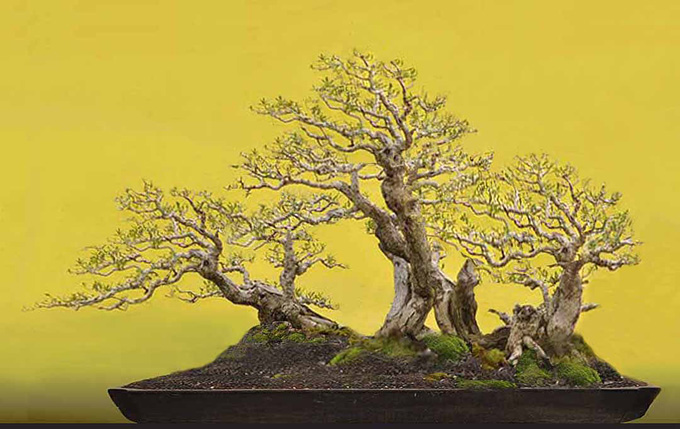
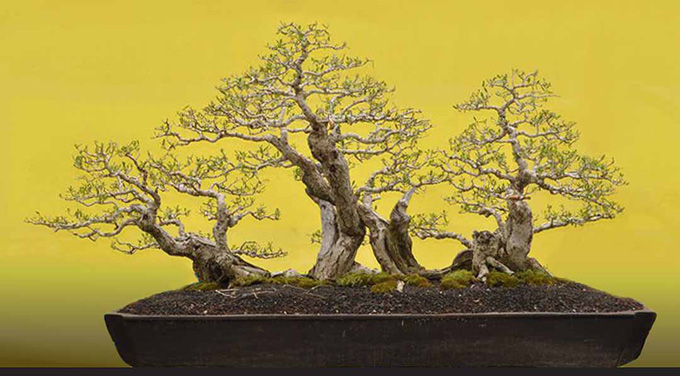
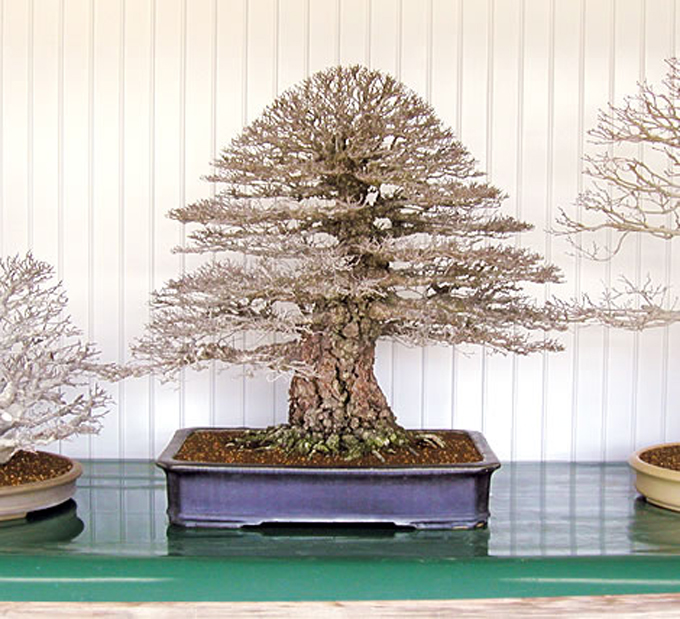
You can find this magnificent elm and other seriously stupendous deciduous bonsai at Andy Rutledge’s The Bonsai Journal in an article by Andy with photos by Boon Manakitivipart.

In a bonsai world dominated by conifers and tropicals…

…it’s a good idea to remember the wonder of deciduous bonsai. Okay, this may be an overstatement, but still, how many top notch elm bonsai do you see on the internet?

Warehouse vacation

Our warehouse is on vacation until July 12th (it needs a break, not to mention a new paint job). Orders placed before then will be shipped on, or soon after, the 12th (that very week at least).

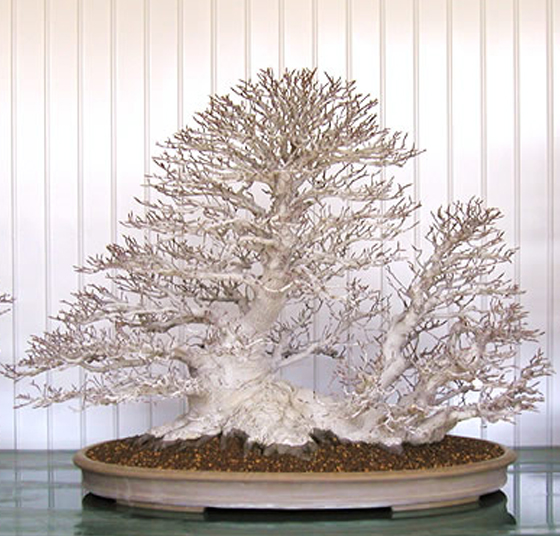
Raft style Japanese beech. You occasionally see someone commenting that North American bonsai has caught up with Japanese bonsai, or other related comments about the limitations of Japanese bonsai (overly stylized is a common one); I think this is wishful thinking by people who aren’t fully paying attention (this is not to say that North American and other Western bonsai -if it makes sense to speak in such generalizations – hasn’t come a long ways in the past few years). This strikingly superior tree is also from Andy’s site.

Our new Bonsai Aesthetics wire

We are virtually out of the 1 kilo size of our new Bonsai Aesthetics wire. Over 200 rolls sold in just under a week took us by surprise. However, we still have plenty of the 100 gram size.

Source: Bonsai Bark Read more!

Tuesday, June 22, 2010

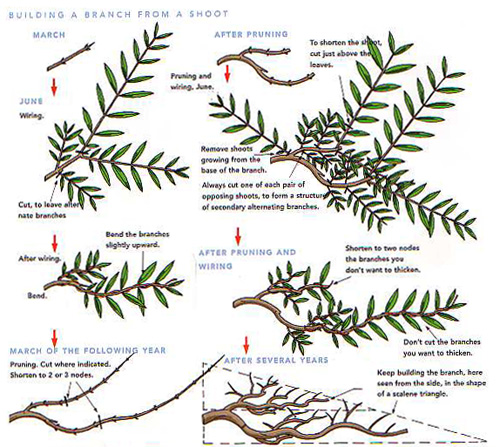
Bonsai tree: Branching tips

branch
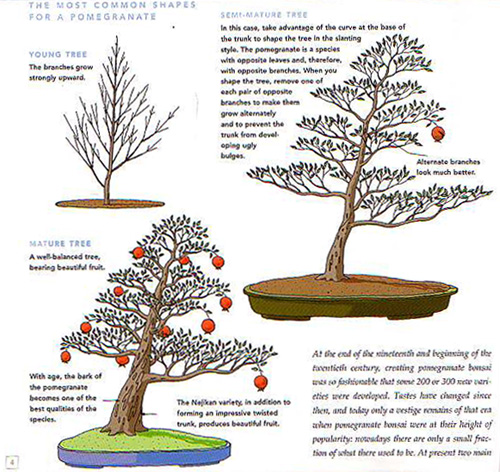
Bonsai branching tips. It’s about Pomegranates, but is applicable to any plant with opposite leaves (as opposed to alternate leaves – Wikipedia has a good description of leaf arrangement).
branch2
These sketches are applicable to almost any deciduous tree. Our apologies for the small type. If you’d like to see the whole article, with a more agreeable font size, Bonsai Today issue 107 is available at Stone Lantern.

Source: Bonsai Bark Read more!

Monday, May 31, 2010

Bonsai tree: Developing Ramification on Deciduous Bonsai

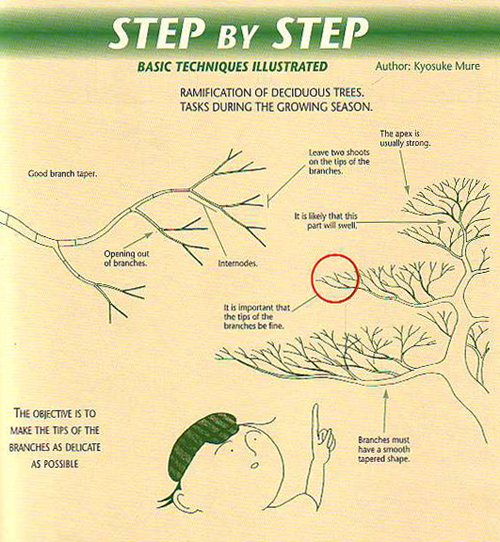
BT66decid
It’s the first of a five page series on ramification that we are running over two posts.
Ramification literally means branch development, or how branches growing. However, when it comes to the art of bonsai it has come to mean branch development that displays a couple key features: taper and fine branching. These features are critical when it comes to developing quality deciduous bonsai.
… but they also lose their shape rapidly. In other words, with the application of some precise pruning and pinching, you can create excellent fine branching on deciduous trees in just a few years. But it’s an on going process that requires continued precise pruning and pinching to maintain.
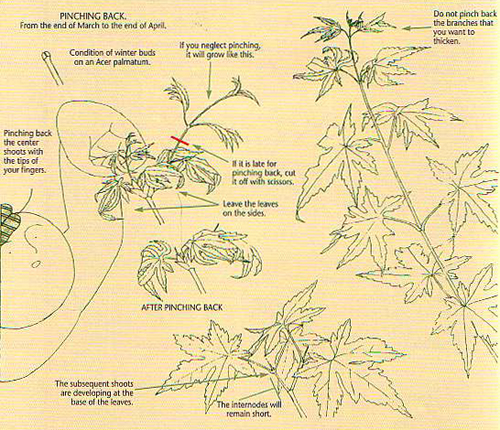
BT66decid2
Pinching back. Notice that is it says the pinching back is done “from the end of March to the end of April.” Exactly when this should occur where you live, depends upon your climate (the original article is from somewhere around Tokyo, Japan; which is about the same latitude as Charlotte, NC). Here in northern Vermont it’s more like from mid to late May until mid to late June.
We’ll run the second installment sometime in the next few days. It includes a work calendar for deciduous trees.

Source: Bonsai Bark Read more!