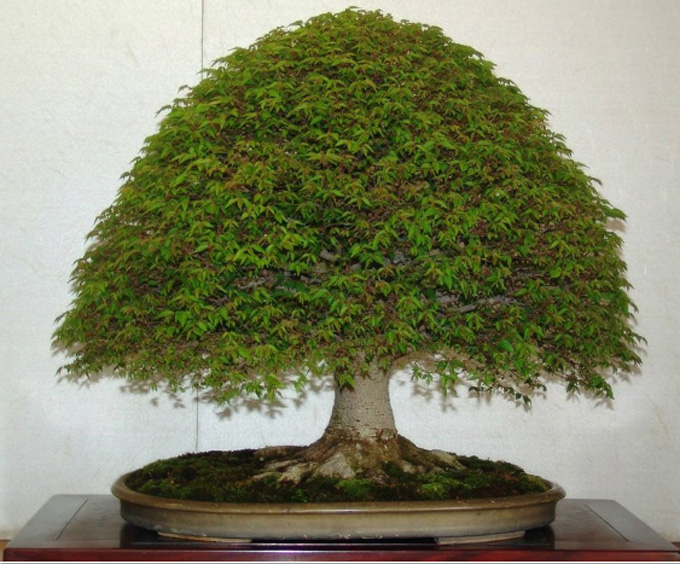
Tuesday, March 20, 2012

Bonsai tree: Selecting a pot for a small trident maple bonsai


Source: Bonsai Tonight

For months, I’d planned on showing a small hinoki in Bay Island Bonsai’s 13th annual exhibit. The hinoki’s health took a turn for the worse and I found myself with a few weeks to prepare another tree for exhibit. I selected a deciduous tree for the exhibit – a root over rock trident maple. I last showed the tree in 2010 in a cream colored oval pot made by Sara Rayner. It was time for a change.


Sara Rayner pot


Trident maple – Sara Rayner pot


I brought the tree and a number of candidate pots to a Bay Island Bonsai workshop for repotting. Before selecting a new pot, I removed the tree from the pot and worked on the roots. For a complete description of the repotting process, see the series of posts beginning with”Repotting a trident maple.”


Trident maple in need of a pot


Ready for a new pot


Selecting bonsai pots for show trees is a favorite activity of mine (see “Pot selection redux” for a similar exercise with a small black pine). Here were my options.


Pot 1


Option #1 – Old Chinese pot


I don’t typically associate trident maples with green pots, but I happened to have several that were the right size. The above oval pot was made in China. It’s about the right size and shape for the maple, but it didn’t strike me as an interesting match.


Pot 2


Option #2 – Old Chinese pot


The next pot I tried was also Chinese. It’s the right size, but very shallow. Not surprisingly, the pot makes the tree look taller.


Pot 3


Option #3 – Japanese pot


This Japanese pot above is much newer than the two Chinese pots. It’s a good size for the tree, but it lacks the character of the older pots.


Pot 4


Option #4 – Sakura pot


The fourth option is a slightly darker green. The curved sides didn’t look right to me and the pot seemed a little on the big side. Next!


Pot 5


Option #5 – Sara Rayner


The fifth pot I looked at is another Sara Rayner pot. A bit on the small side, this pot seemed to bring out the dullness of the stone. Ideally I would like a pot that brightens the composition, but for some reason most of my small, shallow pots are shades of green.


Pot 6


Option #6 – Sara Rayner


The sixth pot was also from Sara Rayner. The size and shape are appropriate, but I found the stripe formed by the lip to be very strong.


Pot 7


Option #7 – Michael Hagedorn


The seventh pot was made by Michael Hagedorn. It’s a very useful pot. One side is a light shade of green. The other side is a darker green.


Pot 8


Option #8 – Michael Hagedorn


The pot is a bit deep for the tree. I think it would look best when the leaves turn color in the fall, but like the other dark-colored pots above, it brings out the darkness of the stone.


I think all of the pots are acceptable for exhibit, but some are better matched to the tree than others. I decided to go with the oldest looking pot, which happened to be the pot with the most interesting shape – the warped, old Chinese pot. Here are some close ups.


Antique Chinese pot


Old Chinese pot


Antique Chinese pot


From below – no chop


I fit what roots I could in the pot and the rest sat above the rim.


Repotting complete


Repotting complete


To dress it up for the exhibit, I placed moss on the surface of the soil (see “Moss technique” for details).


Trident maple


All mossed up – as shown in BIB’s 13th annual exhibit


Because this tree is on the small side, I showed it with another tree, a Japanese black pine I grew from seed. The display would have better balanced were there a greater difference in size between the two trees, but I didn’t have another tree to accompany the maple.


Photo & Video Sharing by SmugMug


Medium display – shohin black pine and chuhin trident maple


 The old Chinese pot was good for the show, but it was a bit shallow for a growing pot. Not long after the exhibit I repotted it in a slightly larger pot. Which one? Pot number 3.


Read more!

Sunday, March 18, 2012

Bonsai tree: Burning Bush—Seasonal Styling and Potting

When I bought this tree from Telperion Farms I was told it had been growing on the grounds of Oregon State University, probably for fifty years or so. I don’t know if that qualifies it as an ‘academic yamadori’. Maybe we need to create a new category of yamadori?


Euonymus is a popular genus for bonsai. The burning bush, Euonymus alata, is not a commonly used species, however, and I was excited to give it a whirl. This photo essay was taken in the creation of this bonsai during the Winter Seasonal of 2012, in February.


The Euonymus after growing in an Anderson Flat for a few years. This photo was taken the day of styling, in February 2012.


The stalwart Howard Griesler of Chicago working with the flex-shaft grinder to bring down the large pruning cuts. (Howard is a foodie and loves our eclectic Portland restaurants...)


The redoubtable John Denny from Iowa working on the rootball. (John is a master brewer, and typically makes sage comments about the local micros).


Both gentlemen washing the rootball of some mucky old soil. I stood far away.


The prepared rootball drying a bit before potting.


Pot prepared... for this tree we used a simple mix of 50% akadama/50% pumice. This is not a perfect pot for the tree, but at least it fits. I'm sure there is a colorful glazed pot in its future, perhaps a dark blue or green.


Right about this time Howard's glasses broke. This was our solution---toothpicks from the kitchen deftly wired into place. It is rare to find an opportunity to wire outside of bonsai! One must take them eagerly whenever they arise.

The final result. It needs a stupendous amount of development, but it's an unusual species for bonsai and I'm curious to see where it goes. Certainly it will give the Japanese maples a run for their money in the fall with its vermillion foliage.


Read more!

Saturday, March 17, 2012

Bonsai tree: A Mystical Dragon

Robert Steven’s simulation of a planting that was submitted by Paolo Netto (see below).


More varied and interesting, but still…

Last month Paulo Netto submitted a group planting for critique by Robert Steven. Now, he’s submitted another more varied and interesting group planting for Robert to critique. Still, no matter how varied and interesting, there’s room for improvement, and ‘room for improvement’ is practically Robert’s middle name.


Paulo Netto’s planting.


Robert Steven’s critique


After the recent critique on Paulo Netto’s grouping, especially on the placement of the gate, he sent me a new grouping with different placement, which showed great improvement in perspective as well as overall composition. The open space in front also shows a much better foreground setting.


However, there are still some points that can be improved.


One of the very important principles of grouping bonsai is to make the panorama look like a part of natural landscape; not a prototype of a backyard garden. So, in this design, I would prefer to take out the wooden fence.


Creating a path is always a good idea in a group planting, but there is a trick to make the path more interesting and natural, and to add artistic value to the creation. In Chinese, this concept is very important and expressed as “Shen Long Jian Shou Bu Jian Wei” (A mystical dragon will only show its head and not the tail). This concept applies to the forming a path or river in landscape bonsai. Never make a straight path or river, but always make it zigzag, curving to the rear with its end point hidden. This will enhance the perspective and create a sense of mystery and an illusion of depth.


Looking at the simulation you can see that I have changed the placement of the gate by partly hiding it behind the trees. This improves the perspective and depth and suggests more mystery.


In addition to all this, all of the trees should be refined to create better ramification.


General comments

There is more than one way to design any bonsai and my critiques and recommended solutions might not always fit your taste and personal preferences, but I always try to give my opinion based on artistic and horticultural principles.


To understand my concepts better, please read my books Vision of My Soul and Mission of Transformation which are available at Stone Lantern.


My bonsai blog address : http://robert-steven.ofbonsai.org


Source: Bonsai Bark Read more!

Friday, March 16, 2012

Bonsai tree: Shopping at the Asia-Pacific Bonsai and Suiseki Convention


Source: Bonsai Tonight

Ever wonder what it’s like to wander around a world-class bonsai convention held in Japan? It’s pretty great. Everywhere I turned I saw wonderful trees, tools, pots, stands and other bonsai paraphernalia. It was fun to see which trees came from which gardens and how much they cost. And because the quality was so high, it was like wandering, at times, through a giant, disorganized exhibit.


The location didn’t hurt either. The convention was held in Takamatsu, a port city on the north coast of Shikoku facing the Inland Sea. The region is famous for producing pine bonsai, lacquer-ware and udon. Convention events were spread between two adjacent hotels at Sunport Takamatsu.


Sunport Takamatsu


Sunport Takamatsu


Many vendors priced their trees on the high side with the expectation that some bargaining would precede the sales. This was particularly true for the more expensive trees. Less expensive items tended to sell closer to their posted prices.


Some people held off their purchases toward the end of the event in hopes of getting a better price. I tended to get what I could while it was still available. At one point I found a box of Kokufu books beneath a sales table – oh boy! In the time it took me to pick up half of the books, another convention-goer grabbed the other half.


By the end of the event, I had filled my bags with pots, tools, books and little quince slabs for displaying accent plants. It was the unpurchased trees, however, that left the greatest impression. What fun it would be to bring some of them home!


Taka senpai's trees


Takayuki Fukushima’s table


Aichi-en trees


Junichiro Tanaka and Ken Fujiwara’s table


Koybayashi's area


Peter Warren at Kunio Kobayashi’s sales tables


Antique stands


Antique stands


Antique root stand


Antique root stand – likely priced well over $10,000


Small pots


Little red and blue pots


Suiseki


Suiseki


Half of the vendors were situated in a tent right on the Inland Sea. The selection inside was great.


Vendor tent


Detached vendor area


In the vendor tent


Trees for sale


Shimpaku for sale


Junipers for sale


One vendor filled two tables with nothing but shimpaku. They ranged from rough material to Important Bonsai Masterpieces.


Young shimpaku


Shimpaku – $1,800


Young shimpaku


Shimpaku – $1,800


Shimpaku


Shimpaku – $21,600


Shimpaku - important bonsai masterpiece


Shimpaku, Important Bonsai Masterpiece – no price listed


Procumbens juniper


Procumbens juniper


The quality really was amazing. Although S-CUBE set the high bar in terms of quality, many vendors offered outstanding trees.


Trident maple


Trident maple


Great hornbeam


Korean Hornbeam


Small deciduous tree


Small deciduous tree in Koyo pot


Black pine


Black pine


Deciduous trees


Assorted deciduous trees


Princess persimmon


Red princess persimmon – $190


A word about princess persimmons – although they look delicious, the experience of eating them is far from enjoyable. Like any unripe persimmon, princess persimmons are very astringent. So much so that after tasting one, my mouth wasn’t the same for a whole week. Has anyone else given these a try?


Read more!