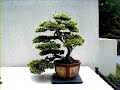
 Short video showing off some great examples of Bonsai trees
Duration : 0:3:30
I recieved a mini bonsai tree kit as a gift. It came with a pot, soil, decorative gravel, and the seeds. How do i set this all up. The pot has a 1 cm whole on the bottom, so how do i put the soil in there without it falling through to the bottom? Also, after i put the seeds in the soil, do i put the decorative gravel on top right away, or do i wait until the seeds have started to sprout? Also, how many seeds should i plant in the pot? The container is only 2in x 2in so it is not very big, so i am guessing you only want to end up with one tree, but do you want to plant more seeds then that? This is my first one and i am very excited about it, but obviously could use some guidance. Thanks for your help!
Put a screen over the hole. You will want this to flow freely for watering. Plant 2 or 3 seeds and the thin them down to one when you see which looks the healthiest. Don’t put on the rocks until this is done. When you water, put the entire plant in standing water,almost to the top. Let it sit there for 20-30 minutes,then remove. Pick up a book on beginning bonsai and learn about it. It requires patience and takes many years to grow one from seed. You probably won’t want to trim the roots for at least a year or two. Be careful not to over prune when shaping your bonsai. Have fun. It is a very satisfying hobby. Please get a book on the subject though,as you will probably have many questions as your bonsai grows.

I hope that someone can help me. i want to start a bonsai tree and i’ve been told that i can do this by cutting off a small branch from a bush or a very young tree. is this true? please respond. thanks.
i understand that you can use rooting powder to encourage the growth of roots on cuttings. the important thing though is that you have to have a smooth cut to work with. a jagged cut will just rot in water and also harms the tree you take it from.
Let't talk a little about roses on Bonsai Life blogspot.
Before you pay out good money for a rose, make sure you’re getting a premium-quality plant. It should have green shoots and smooth, well-ripened wood that doesn’t yield to the touch when pressed. Roses sold in plastic bags should have a fresh, green look to them: if they’ve been stored too long, or in excessively dry conditions, they’ll have a shriveled look and may produce shoots prematurely. If you buy roses by mail order, you obviously can’t check them before you buy, so use a reputable supplier.

A grade-one bare-root bush rose tree must have a minimum of two good shoots, each with the diameter of a thick pencil. The stems must look fresh, not shriveled. The roots must be fibrous and in a moist condition, with a minimum length of 10 in (25 cm). Container-grown, containerized and prepack roses must meet the same standards as hare-root plants.
Roses are sold in a number of different ways. Traditionally, growers lift them in autumn and sell them bare-rooted, either individually or in quantity (which makes them cheaper). Bare-rooted roses are often excellent value for money.
Plastic bags or boxes Sometimes roses are sold bare- rooted in plastic bags or boxes. These are packed in moss or other organic materials, and are often sprayed with a harmless wax to prevent evaporation. The roots and shoots are trimmed to fit the bag or box, but still need pruning in the spring.
A more reliable way of growing roses is to buy them containerized with their own root ball, ready for planting. These, too, are pruned ready for planting and are often covered with a thin layer of wax. Because the roots have their own root ball, they are likely to get off to a better start after planting.
Container-grown plants are even more likely to transplant well, as their roots will not be disturbed whets they are moved. Before you buy a container- grown rose, check that it has actually been grown in the pot rather than containerized, and make sure it has a well- developed root system. If it doesn’t have its own solid root ball, leave it in the pot when you plant it, and don’t remove it from the pot until the autumn.
There are obvious advantages its buying your roses from a local nursery or garden centre, especially one that you know has a good reputation. Apart from the convenience, you can easily check the quality and condition of the plants. Mail order is riskier, although you may have little choice if you want an unusual variety.
Read more!
I’m thinking of getting a bonsai tree…
Any tip? Best price? Advice?
The hardest part to give advice on is choosing a Bonsai. This is because I guess it is a very personal thing. The best advice I can give is get a bonsai that somehow "moves you" – one that shouts out at you "Take me home with you"
On the Practical Side of things:
a) Get a Bonsai that will grow in your environment, i.e., do you live in a flat, do you have a garden, do you live in a COLD or Warm part of the world.
b) If you keep house plants, get a Bonsai that similar to a house plants, Ficus, Chinese Elm, Jade Trees and the like..
c) Do a little bit of research – find out about trees in your garden or neighborhood – these are more likely to survive with you…
 Some of the quercus sp. types with a persistent leafage through the whole year have a powerful and leafy form, are capable in to resisting the most severe climatic conditions. Both cork and rock oak leaves from the face side are soft and smooth, having a dark green color, oval form, with the prickles on the edges, and from the inside the velvety surface of whitish color. The trees have a slow tempo in growth, which contributes to the formation of a very powerful trunk and surprisingly beautiful crowns, sometimes it makes an irregular open shape. Acorns - typical and recognizable fruits of oak. They are covered with brown rind with a small cap in the base of fruit.
 They are moved out to dry and hot solar places, where they look noticeably. Cold winter, even when temperatures are below the freezing limit, doesn’t represent any threat for the oak, although, because of the limited volumes of the soil, in which the roots are developed, it should always be conceled. The minimum water supply and rare irrigations are possible only during complete drying of substratum with the ideal drainage of soil. The introduction of fertilizer is produced in spring and in autumn. Every one-two years repot, ensuring with dense clay basis with an addition of 1/3 of plant compost.
 It is necessary to remove leaves fallen during the year and to brush the base of the stem of the rocky oak, because of the surplus of humidity green spots appear there. The increase of the plants is controlled by trimming, since their slow development and hardness of wood do not give effect with wiring, especially for the cork oak, which possesses a very vulnerable crust.
 Read more!
 The most of the plants from this specie are the natives of the northern hemisphere and are fitted out to any medium. These are the inhabitants of coast, which grow on the strip of the adjacent to the beach dunes, which grow at the steepest abrupt and most unapproachable apexes. They all can become majestic bonsai. Pinus incinata and Pinus mugo are the most valuable because of the size of the aches and small height.
 is necessary for pine trees the whole year; therefore they require arrangement at the open and solar places. It should always be selected a well warmed place for the best growth of the tree. The only exceptions are the superfluously moist and closed places with poor air ventilation, especially in the rainy season and frost, since such conditions are heavy for the roots. Irrigation must be moderate. It is possible to manage without sputtering water from the pulveriser even in the summer period, since the pine trees fell well in hot and dry medium. To prepare a good soil, it should be considered the needs of each species, since some plants need exceptionally lime soils, others in the clay and siliceous and even sandy soils. Fertilizer must be introduced on the peak of the development of plant from the beginning of the spring to the autumn only before the radical trimmings or after transplantation. Transplantation should be produced before the appearance of the first flights, trying with the cutting of roots not to injure pivotal root.
 known and one of the most popular - Juniper bonsai. It habituates in the northern hemisphere of the World. For growing a bonsai, it best suits species form South-Est of Europe and Asia.
 Every king of Juniperus sp. is felling well under high-level sun radiation, but suffers being in a dark place(except heated seasons, when we talk about young plants).Juniper is very steady to most uncomfortable weather state and temperature, though when it is frosty weather you should guard its rhizome. Juniper does not attach to the group of plants which needs a lot of watering, so it is recommended not to water until the soil is fully dry. It is also not recommended to settle the plant in high humidity environment. Adding nutritive material best suits to a warm time of the year in a moderate way. You should not abuse using nutritions, when it is a favorabil season to browse.
 Because of the low growth it is not a must to cut branches for changing the direction of the trunk, but it would be much more useful to wire, that could be done in autumn and un-wire not earlier than 7-8 months.
 With the help of fungicide, especially sistematical, you could get rid of it. In this case you should necessarly remove dry branches, to eliminate the possibility of uncontrolable spreading of the fungus.
Read more!
With the help of fungicide, especially sistematical, you could get rid of it. In this case you should necessarly remove dry branches, to eliminate the possibility of uncontrolable spreading of the fungus.
Read more!


