Showing posts with label root. Show all posts

Tuesday, April 13, 2010

Bonsai tree: Repotting a Japanese maple

Back in winter I took a few photographs of an air-layered Japanese maple getting repotted during a Bay Island Bonsai workshop.
Combing out the roots – Japanse maple ’sango kaku’
The new roots are well established. The next step is to get them to fuse while improving the ramification. Jeff, the tree’s owner, kicked off this phase by bare-rooting the tree and repotting it into a large, shallow, growing container.
Read more!

Tuesday, March 16, 2010

Bonsai tree: Maples

The Bay Area Bonsai Associates (BABA) held their 28th annual show at Lakeside Garden Center in Oakland, California. The show included a good number of maples bonsai. Some of my favorites belonged to local bonsai enthusiast Jay McDonald.
Jay is active in a number of clubs and has contributed greatly to the local scene. He acquired the maple below some time ago and has done a great job developing the ramification.
Japanese maple
Read more!

Wednesday, January 27, 2010

Bonsai contest

IMG_2453
This is a Cape honeysuckle (Tecomaria capensis), by Ken T. I like the knob on the right that makes the tree unique and tells a little story. I can still see a few things that might improve it.

1. The soil line could be just a little higher so the base of the tree would have more anchored feel. Generally saying this is just to lower the tree in the pot.

2. Perhaps letting the crown grow up higher in the center and then rounding it off some would balance the tree a little better.

3. The roots from the surface should be more covered with soil.

4. If turning the tree counterclockwise, it the view could be better.
flowering serissa for contest at stone lantern 010
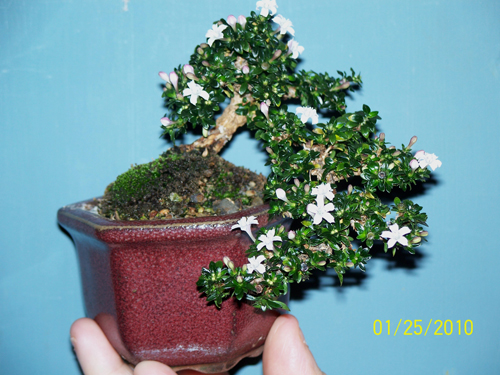
This is a flowering serissa by Brian and Jill. It is healthy, the flowers are great and the strong little trunk is a good start. A too large pot can work for growing on and encouraing development, so maybe that is their intention.
contest
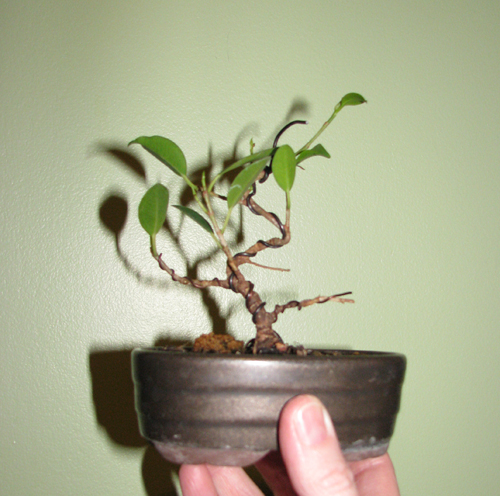
This is a little ficus by Susan Richards. I like the way the trunk is wired. It promises a good future for this sparse little tree. Right now the sparse leaves are way too big for the tree, as is the pot; at least for show purposes Read more!

Sunday, January 24, 2010

Fantastic Junipers

bt57-p007

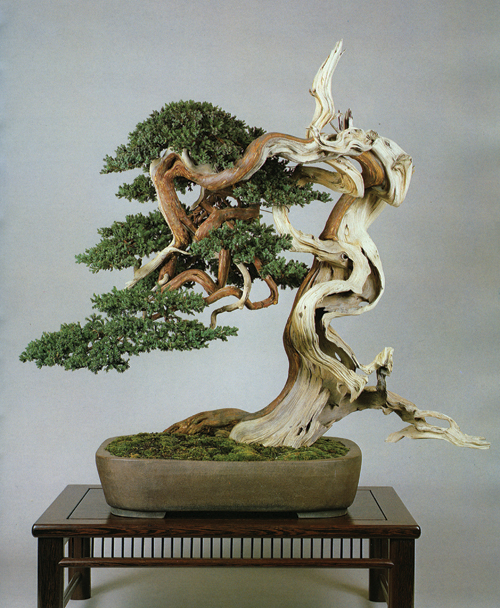
This is a Shore Juniper (J. procumbens) by master bonsai innovator, Masahiko Kimura. It combinse the sculptural look that has been favored by some Japanese bonsai artists with a more wild, ruged natural look that is in favour in much for the world bonsai community. If bonsai is an art, then the categories are continually being broken down as artist play, explore and inovate. And no bonsai artist that has played, explored and inovated more successfuly thanMaster Kimura.
Junipers are tough, durable and flexible and pruneable. They don’t mind having their roots hacked and they take to container culture. Their needles tend to be small and dense and both their needles and bark come in a range of attractive colours and textures. Perhaps best of all, junipers take to carving like few other plants and their deadwood is both attractive and long lasting especially if you keep it clean and apply lime sulfur.

bt26-p058

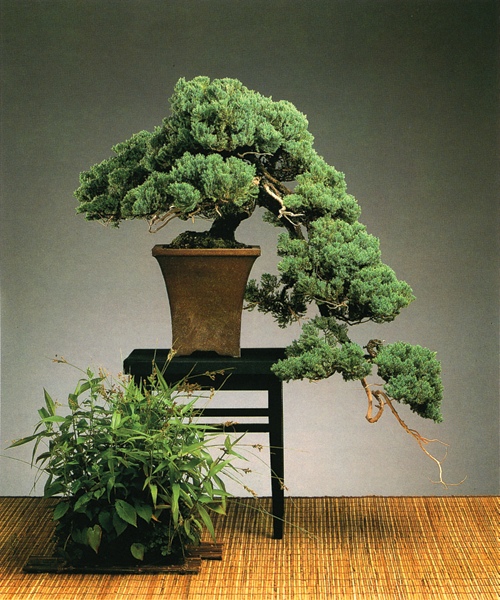
Dwarf Japanese garden juniper. One thing I do know is that it is unmistakably a Procumbens nana; a dwarf cultivar of the Procumbnes. Procumbens nana is by far the most popular juniper for beginners, at least here in the States. However, you seldom see a masterpiece, as the trunks tend to stay too thin. The trunk on this one is about a thick as they ever get. Read more!

Tuesday, December 15, 2009

Repotting a trident maple: root-work


Part 3 of 5

I’ve seen it first-hand. Visting bonsai teachers come to town and whip trees into spectacular shape only to leave the trees’ owners with ticking time-bombs. Until a tree is in outstanding health, it’s a poor candidate for even the most basic bonsai tasks. Great bonsai work requires great health, and great health begins with the roots. If you hear otherwise, think twice before handing over the scissors.

All of this to say that repotting is serious business. Cuting too many roots can weaken or kill a tree – not cutting enough can lead to root rot or die back and prevent good nebari from developing. When done well, however, repotting can invigorate bonsai and give them the strength to recover from the most intensive styling techniques. That’s why repotting has always been among my favorite tasks. It’s an art unto itself, and it’s never failed to keep me interested.

Trident maple is best repoted in late winter or early spring. And while most deciduous trees are typically repotted before they leaf out, tridents can be repotted as long as the leaves are ruddy. Repoting this late can slow a tree down a bit, but if it’s in otherwise good health, it won’t skip a beat.

Root-work begins, in this case, with the botom of the rootball. To get to the bottom I have to tip the tree onto its side. After removing the tree from the pot I can see that the roots are loose where the sickle passed, but nice and compact on the other side. If I tip the rootball onto the side where the sickle passed, I can damage loose roots. Tipping the tree onto the untouched side can protect the rootball while I work on the base. This explains why I begin with the bottom of the rootball. If I start with the top or the sides, I’ll be exposing roots that could get damaged when I turn the tree onto its side.


Read more!

Saturday, November 7, 2009

How do you grow a bonsai tree the right way?

From email:

I am trying to grow a bonsai tree but I don’t know when to trim the roots and the branches and how much to trim. If you can please give me some tips and advice I would really appreciate it.


Answer:
Make sure your bonsai tree gets at least 3 hours of sunlight every day. This is essential if you are growing your tree indoors.
Maleable wiring is used to give your bonsai tree the shape you want. For trimming and pruning, use a concave cutter — it’s a tool designed to prune the plant without leaving a stub. Shears, pliers, and branch bending jacks are other efective tools for pruning. Read more!

Thursday, April 2, 2009

Pinus sp.

The most of the plants from this specie are the natives of the northern hemisphere and are fitted out to any medium. These are the inhabitants of coast, which grow on the strip of the adjacent to the beach dunes, which grow at the steepest abrupt and most unapproachable apexes. They all can become majestic bonsai. Pinus incinata and Pinus mugo are the most valuable because of the size of the aches and small height.
Pine trees have the unique crust, formed by numerous shield-shaped plates and fish-scales of the irregular shape, which easily are separated from the stem. The needles are grou
ped on the branches, beginning from the formation of small beams from two to five needles, but the remaining surface is covered with scaly needle without the chlorophyll. Seeds in the majority of the cases are winged and resound by wind. Both needles and cloths of stem and branches have glands, which release resin - very dense substance, which heals and which protects pine tree from the pathogenic organisms.

Caring in vegetation period


Sunlight is necessary for pine trees the whole year; therefore they require arrangement at the open and solar places. It should always be selected a well warmed place for the best growth of the tree. The only exceptions are the superfluously moist and closed places with poor air ventilation, especially in the rainy season and frost, since such conditions are heavy for the roots. Irrigation must be moderate. It is possible to manage without sputtering water from the pulveriser even in the summer period, since the pine trees fell well in hot and dry medium. To prepare a good soil, it should be considered the needs of each species, since some plants need exceptionally lime soils, others in the clay and siliceous and even sandy soils. Fertilizer must be introduced on the peak of the development of plant from the beginning of the spring to the autumn only before the radical trimmings or after transplantation. Transplantation should be produced before the appearance of the first flights, trying with the cutting of roots not to injure pivotal root.

Styling the bonsai


Needles in autumn are moved away, removing the dry and damaged needles at any time of year. Since the beginning of the appearance of new flights the needles should be removed, leaving about 1/3 of it in order to stimulate the appearance of smaller and more numerous needles. If on a branch appear immediately two flights, then the longest flight should be removed. Pruning branches should not be performed in the period of an intense growth of the pine tree, when the loss of resin can be very significant; branches should be cut in autumn. For changing the direction of branch growth it is necessary, prior to the beginning of the rest period, to wire them, dismantling them only in spring.

Illness and wreckers


It is necessary to scrupulously inspect leaves and branches in order to reveal the wreckers, which were settled on the tree (silk cocoons of the caterpillars of march silkworm, larva of beetle - grinders, aphis and woodlice). All this must be thoroughly processed by chemicals in order to avoid their propagation. From the most extended diseases it is possible to expect the appearance of brown abscesses, rust and root white rot. The introduction of poor quality fertilizer can cause the appearance of dry or reddish tips in needles, it is possible to entangle it with the fungus infection.

Typical forms of species


Pinus cembra. European cedar (European cedar pine tree). The alpine pine tree, which is possible to achiev remarkable results in the style “cascade” and “the tree, bent by wind”. Pinus sylvestris. Forest pine tree (usual pine tree). It issues characteristic pale crust, and also small needle and pine lumps. The mountain regions of the European continent are natural living environment; therefore this form of pine tree is fitted out to the extremely unfavourable climatic conditions. The separately appreciated property is the dual painting of its needles, dark green outside and gray from within. Pinus densiflora. Dense flower pine tree. Native of Asian continent. One of two undersized forms together with Pinus of mugo from the pinus sp., that are developed in the form of bushes, especially in the first years of life. Pinus mugo. Mountain pine tree. Natural living environment is located in the central Europe mountains. It is characterized by slow increase and thickset form in the adult state, which makes it separately suitable for the cultivation in the container. Pinus nigra. Austrian pine tree (s. black Austrian). Native of South and central Europe. It grows on the lime-stony soils. It has long, flexible and almost dark needle. Pinus pentaphylla. Himalayan pine tree. The native of Japan contains in the beam five needles. In contrast to the rest of the kinds when cutting of branches it is recommended not to touch the place it was cut, till it is completely dry.
Read more!