Showing posts with label pot. Show all posts

Wednesday, January 20, 2010

A Connoisseurs Photo Gallery

olive
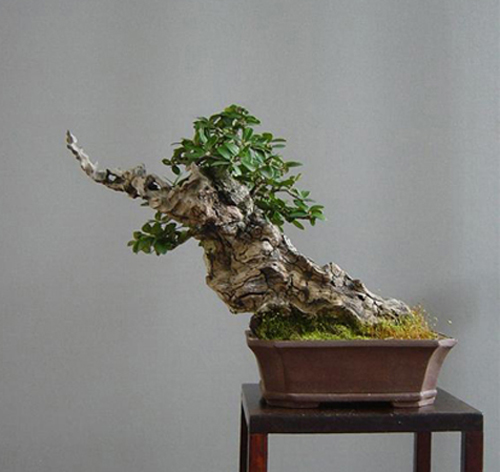
The gnarled, cracked deadwood tells this old olives story. Yixing pot.
carpinus
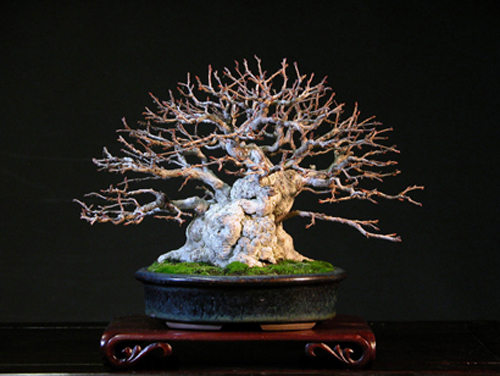
The masive old trunk with its bumps and crack that tell an ancient story, captures our eye; but what about the fine branching on such a small tree? This type of refinement that is often overshadowed by thick trunks and dramatic deadwood, also tells a story; a story of time put in triming and wiring and waiting for new shoots to grow. Read more!

Sunday, January 17, 2010

Amazing Pots and Monterey Cypress

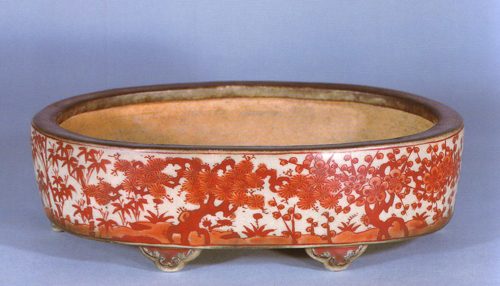
redpot

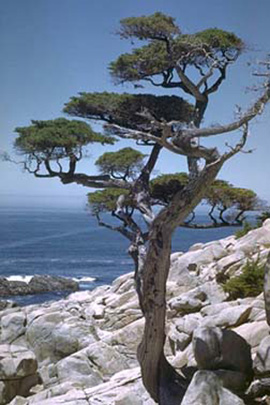
This is a wind-shaped Monterey cypresses. I will have some more photos after I make order in them.

Cmacro10

Amazing landscapes on California Coast.


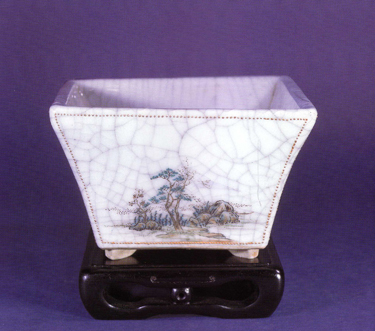
smallwhite

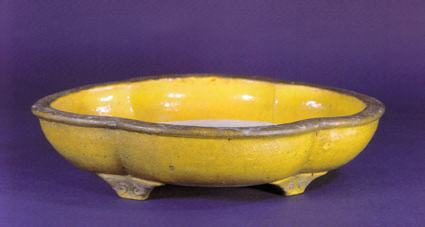
yellowpot

lowpot

mountainpot
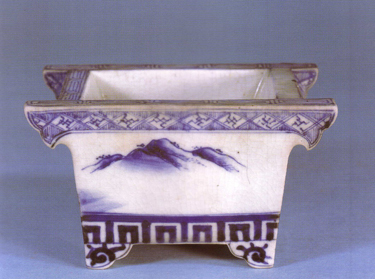
Interesting pot art, I would like to give such a home for at least some of my bonsai's. Soon I will try to find some in my hometown. Read more!

Friday, January 15, 2010

Which One of the Pot Colors Works Best?

4pots3
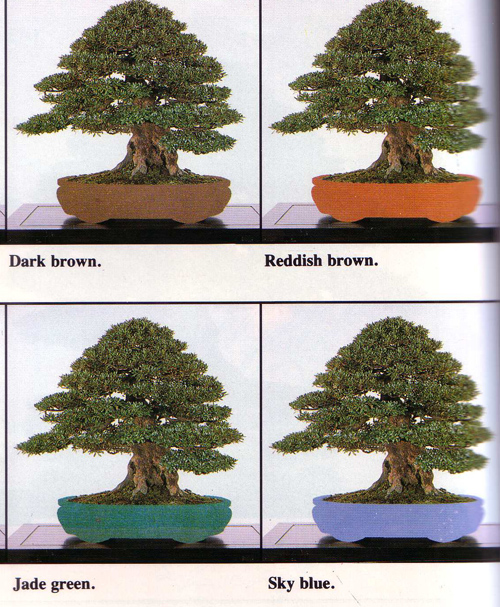
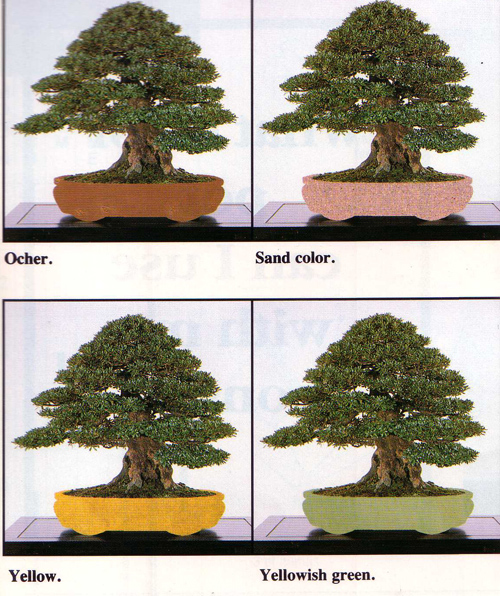
This post shows a Satsuki azalea in twelve colored pots. Would your choice be different if the flowers were white? Pink? Red? Tricolor? Colors will vary depending upon our scanner, the settings on your screen and who knows what else? Don’t worry though, it’s all just a game and there is no correct answer.
4pots2
4pots1
Read more!

Monday, January 11, 2010

About pot selection

Bonsai Tonight has a good article on pot selection that is worth reading. I have been looking for several different kinds of pots lately, but for an entirely different reason. I have been strugling with the best type of grow pot for future bonsai. Maybe I will blog about it once my research is done. For now, head over to Bonsai Tonight

http://bonsaitonight.com/2010/01/05/show-pots/
http://bonsaitonight.com/2010/01/08/pot-selection-redux/ Read more!

Thursday, January 7, 2010

Rafting in a Bonsai Pot

maple4
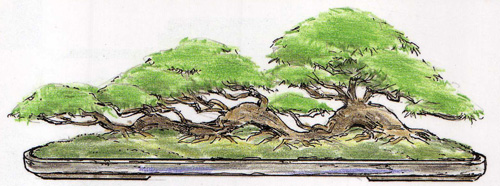
This very well rendered drawing by Peter Adams is from his book ‘Bonsai with Japanese Maples.’ It apears in a section called ‘Creating Raft Trees’ and on the back cover of the book. Whether or not this drawing comes from a tree in Peter’s colection or is just from his imagination. But one thing we do know; a pot that big will most likely set you back several hundred dollars.

Rafting in Peter’s own words
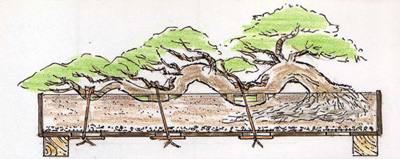
The raft method is formed by laying a tree on its side and encouraging it to root along the recumbent trunk. The branches on the under side of the old trunk are removed to facillitate it lying comfortably in the new posture. Other branches are left and are developed into trees.

We are just here to whet your appetite
maple3 
You can use a box while roots are developed along the trunk, and if you can’t afford a suitable pot, you can always leave it there.

maple1&2 
The early steps: top to bottom. Notice how the upper limbs are wired to form interesting trunk shapes and how the lower limbs are removed before poting.

Interested in Japanese Maples
Try the Pocket Guide to Japanese Maples. It is thoroughly excellent and a great value at $19.95
Read more!
Tuesday, January 5, 2010

Pot show


In Japan, it’s common for bonsai profesionals to repot bonsai into show pots so they look their best during an exhibit. For some of the more prestigious shows. Shortly after the trees return from exhibition, they are returned to their growing pot.

Why not grow bonsai in show pots all year around? There are two reasons. Sometimes show pots are worth more than the trees they contain. Antique Chinese pots can cost over $100000. Growing trees in such expensive pots is an unnecesary risk when a hard freeze or an accidental slip can be so costly.

Show pots also tend to be a bit smaler than growing pots. While it is posible to keep trees healthy in small pots, it’s far easier to keep them happy in more generously sized containers.

I like to see what a tree looks like in a given container before making a final decision. I line up a variety of pots to see how the tree looks in each. Some pots emphasize a tree’s silhouete, others, the curve of the trunk. The color of the clay can complement the bark as well as the foliage, and even small details like a pot’s “feet” have a big effect on the ensemble.
Here are photos of eight of the pots I tried with a small pine (11″) I will be showing in two weeks. I was surprised how many work well with the tree.
Have any favorites? Would any make you want to stay home from the exhibit? Feel free to comment – I’ll post my selection in a few days.


Pot 1 – Chinese


Pot 2 – Yamaaki


Pot 3 – Chinese


Pot 4 – Sakura


Pot 5 – Chinese


Pot 6 – Japanese


Pot 7 – Bunzan


Pot 8 – Nanban
Read more!

Saturday, January 2, 2010

Michael Hagedorn’s Ezo Spruce

sprucefinal1

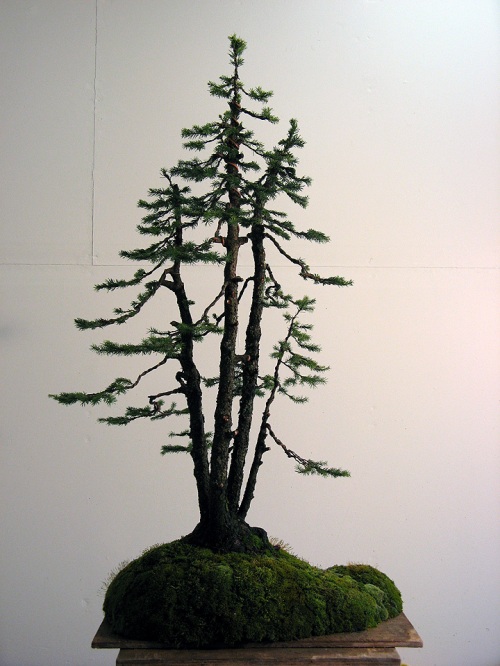
As we are on the subject of ezo spruce, I thought you might want to see this potless ezo clump from Michael Hagedorns Crataegus Bonsai.

Here’s what Michael Hagedorn has to say about this planting: “I have the tree on a wooden board, which will be temporarily supported for about 2 years. After that time, I hope the roots will be solid enough to support the entire kokedama and be able to be placed directly on a bench — sans pot or slab.”
Michael Hagedorn is an accomplished and well known bonsai artist and teacher. Michael lives, practices and teaches in Portland Oregon. Read more!

Tuesday, December 8, 2009

Repotting a trident maple: removing the tree from the pot


Part 1 of 5

Preparing a trident maple for exhibit requires a lot of work. Fortunately, most of this work happens long in advance of the exhibit. Having developed what branches I could this summer, all that remains is a little clean-up and repotting.


Root-over-rock trident maple

Plucking spent leaves and removing extraneous branches doesn’t take long. Repotting, in this case, doesn’t take long either, though it must be done with care. I’ve owned this tree long enough to know that it needs repotting every year, but the work is usually straightforward.

Read more!

Monday, October 12, 2009

How to grow a mini bonsai tree?

I recieved a mini bonsai tree kit as a gift. It came with a pot, soil, decorative gravel, and the seeds. How do i set this all up. The pot has a 1 cm whole on the bottom, so how do i put the soil in there without it falling through to the bottom? Also, after i put the seeds in the soil, do i put the decorative gravel on top right away, or do i wait until the seeds have started to sprout? Also, how many seeds should i plant in the pot? The container is only 2in x 2in so it is not very big, so i am guessing you only want to end up with one tree, but do you want to plant more seeds then that? This is my first one and i am very excited about it, but obviously could use some guidance. Thanks for your help!

Put a screen over the hole. You will want this to flow freely for watering. Plant 2 or 3 seeds and the thin them down to one when you see which looks the healthiest. Don’t put on the rocks until this is done. When you water, put the entire plant in standing water,almost to the top. Let it sit there for 20-30 minutes,then remove. Pick up a book on beginning bonsai and learn about it. It requires patience and takes many years to grow one from seed. You probably won’t want to trim the roots for at least a year or two. Be careful not to over prune when shaping your bonsai. Have fun. It is a very satisfying hobby. Please get a book on the subject though,as you will probably have many questions as your bonsai grows.

Read more!

Thursday, April 2, 2009

Pinus sp.

The most of the plants from this specie are the natives of the northern hemisphere and are fitted out to any medium. These are the inhabitants of coast, which grow on the strip of the adjacent to the beach dunes, which grow at the steepest abrupt and most unapproachable apexes. They all can become majestic bonsai. Pinus incinata and Pinus mugo are the most valuable because of the size of the aches and small height.
Pine trees have the unique crust, formed by numerous shield-shaped plates and fish-scales of the irregular shape, which easily are separated from the stem. The needles are grou
ped on the branches, beginning from the formation of small beams from two to five needles, but the remaining surface is covered with scaly needle without the chlorophyll. Seeds in the majority of the cases are winged and resound by wind. Both needles and cloths of stem and branches have glands, which release resin - very dense substance, which heals and which protects pine tree from the pathogenic organisms.

Caring in vegetation period


Sunlight is necessary for pine trees the whole year; therefore they require arrangement at the open and solar places. It should always be selected a well warmed place for the best growth of the tree. The only exceptions are the superfluously moist and closed places with poor air ventilation, especially in the rainy season and frost, since such conditions are heavy for the roots. Irrigation must be moderate. It is possible to manage without sputtering water from the pulveriser even in the summer period, since the pine trees fell well in hot and dry medium. To prepare a good soil, it should be considered the needs of each species, since some plants need exceptionally lime soils, others in the clay and siliceous and even sandy soils. Fertilizer must be introduced on the peak of the development of plant from the beginning of the spring to the autumn only before the radical trimmings or after transplantation. Transplantation should be produced before the appearance of the first flights, trying with the cutting of roots not to injure pivotal root.

Styling the bonsai


Needles in autumn are moved away, removing the dry and damaged needles at any time of year. Since the beginning of the appearance of new flights the needles should be removed, leaving about 1/3 of it in order to stimulate the appearance of smaller and more numerous needles. If on a branch appear immediately two flights, then the longest flight should be removed. Pruning branches should not be performed in the period of an intense growth of the pine tree, when the loss of resin can be very significant; branches should be cut in autumn. For changing the direction of branch growth it is necessary, prior to the beginning of the rest period, to wire them, dismantling them only in spring.

Illness and wreckers


It is necessary to scrupulously inspect leaves and branches in order to reveal the wreckers, which were settled on the tree (silk cocoons of the caterpillars of march silkworm, larva of beetle - grinders, aphis and woodlice). All this must be thoroughly processed by chemicals in order to avoid their propagation. From the most extended diseases it is possible to expect the appearance of brown abscesses, rust and root white rot. The introduction of poor quality fertilizer can cause the appearance of dry or reddish tips in needles, it is possible to entangle it with the fungus infection.

Typical forms of species


Pinus cembra. European cedar (European cedar pine tree). The alpine pine tree, which is possible to achiev remarkable results in the style “cascade” and “the tree, bent by wind”. Pinus sylvestris. Forest pine tree (usual pine tree). It issues characteristic pale crust, and also small needle and pine lumps. The mountain regions of the European continent are natural living environment; therefore this form of pine tree is fitted out to the extremely unfavourable climatic conditions. The separately appreciated property is the dual painting of its needles, dark green outside and gray from within. Pinus densiflora. Dense flower pine tree. Native of Asian continent. One of two undersized forms together with Pinus of mugo from the pinus sp., that are developed in the form of bushes, especially in the first years of life. Pinus mugo. Mountain pine tree. Natural living environment is located in the central Europe mountains. It is characterized by slow increase and thickset form in the adult state, which makes it separately suitable for the cultivation in the container. Pinus nigra. Austrian pine tree (s. black Austrian). Native of South and central Europe. It grows on the lime-stony soils. It has long, flexible and almost dark needle. Pinus pentaphylla. Himalayan pine tree. The native of Japan contains in the beam five needles. In contrast to the rest of the kinds when cutting of branches it is recommended not to touch the place it was cut, till it is completely dry.
Read more!