Showing posts with label Bougainvillea. Show all posts

Wednesday, September 14, 2011

Bonsai tree: We Have A Winner

This is the tree that gave people the most trouble. You can blame facebook if you’d like (unattributed and mis-attributed bonsai abound in that crazy free-for-all world). We have Robert Steven to thanks for setting us straight on this one. It’s a Pemphis acidula and the artist is Adjie Christian.

And the winner of our $100 Mystery Bonsai Contest is….

Master Bonsai Detective, Joe Rauscher. For his diligence, Joe will receive a $100 gift certificate to Stone Lantern (scroll down to the bottom for the correct answers).

A close second

Ferry Freriks was hot on Joe’s heels, so we’ve decided to give Ferry a $50.00 gift certificate for his equally impressive, but sadly a little slower detective work. There’s another egg-on-my-face story her: I missed Joe’s winning email and told Ferry he had won (in my defense I get about two trillion emails a day, but I won’t mention it because I’m no fan of lame excuses). So apologies to Ferry and I hope your second place gift helps with the disappointment.
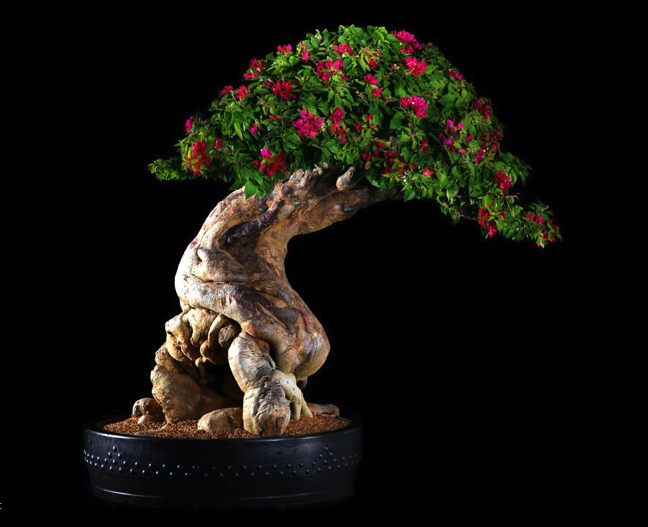
Some one labeled this Bougainvillea (by Nacho Marin)  ‘Ficus’ on facebook, but both Joe and Ferry saw through that ruse.

Here’s a later shot of the tree at the top of this post. You can tell it’s later, because….?

BTW: it’s with this photo is (on facebook) that Robert Steven correctly identifies the real artist.

Joe (and Ferry’s) correct answers

1) Juniperus chinensis, Silvia Kadasch

2) Rhododendron Indicum (Satsuki azalea), Andres Alvarez Iglesias

3) Bougainvillea Glabra, Nacho Marin

4) Juniperus Chinensis “Itogawa”, Carlos Vandervaart

5) Rhododendron Indicum (Satsuki azalea), Suthin Sukosolvisit

6) Pemphis acidula, Adjie Christian

Source: Bonsai Bark Read more!

Sunday, April 10, 2011

Bonsai tree: Power, Color & A Too Little Forest

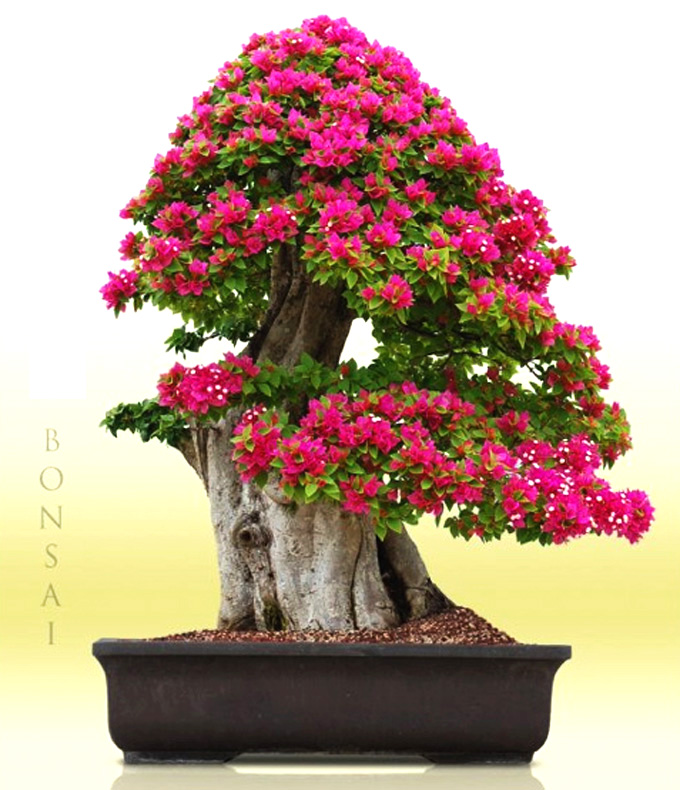
Bougainvillea, Wigert’s Bonsai. I originally captured this impressive monster on facebook. I took the liberty of photoshopping to soften the background a bit. In the process, the flowers brightened some (a result of limited photoshop skills, no doubt). Still, even without my help, this tree exhibits a striking combination of power and color. You can visit Wigert’s Bonsai Gallery to see another shot in a different setting.

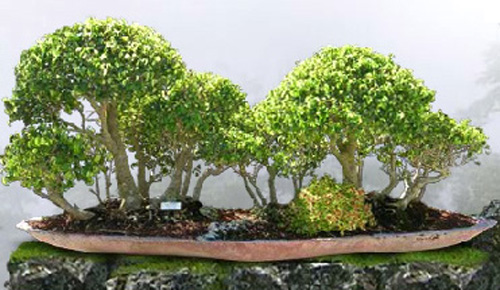
Too Little Ficus Forest. This one was lifted straight from Wigert’s Gallery. It’s cropped a little tight to eliminate some background text, but even so, its balance and beauty are obvious. I like the choice of trees, the arrangement, the sense of depth, and almost everything else about this planting (it would have been better to remove the distracting white tag), including the remarkable pot with its coral/pink blush.

Source: Bonsai Bark Read more!

Tuesday, November 30, 2010

Bonsai tree: Tropical bonsai at the National Bonsai and Penjing Museum

Source: Bonsai Tonight
Tropical bonsai at the National Bonsai and Penjing Museum

The National Bonsai and Penjing Museum in Washington D.C. contains a number of bonsai that need far more warmth and humidity than D.C. winters can provide. They are housed in a greenhouse at the museum where they are currently thriving despite the impending cold weather. I’ve included photos of several below along with a few trees from the North American and Chinese Collections.

As before, the photos are presented in order of number of years in training, beginning with the longest in training. The banyan below has been in training since 1906.

Ficus microcarpa - Chinese Banyan. In training since 1906. Donated by Shu-ying Lui. Chinese Collection.

Ficus microcarpa – Chinese Banyan. In training since 1906. Donated by Shu-ying Lui. Chinese Collection.


Crataegus laevigata – English Hawthorn. In training since 1953. Donated by Bertram F. Bruenner. North American Collection.


Bougainvillea glabra – Bougainvillea. In training since 1969. Donated by James J. Smith. North American Collection.


Ficus microcarpa ‘Retusa’ – Chinese Banyan. In training since 1971. Donated by Mike Uyeno. North American Collection.


Schinus terebinthifolius – Christmas Berry. In training since 1973. Donated by Edward Nakanishi. North American Collection.


Conocarpus erectus – Buttonwood. In training since 1975. Donated by Mary Madison. North American Collection.


Acer buergerianum – Trident Maple. Donated by Stanley Chinn. Chinese Collection.


Acer buergerianum – Trident Maple. Donated by Michael Levin.

There were a number of signs that fall was upon us around the garden. Banana foliage in the Chinese Pavilion had recently been hit by frost. Elsewhere, fall colors filled the museum.


Garden at the Chinese Pavilion.


Japanese Laceleaf Maple – beautiful fall color.


Japanese Laceleaf Maple.

I’d like to thank Jack, Aarin, and the many volunteers that maintain these trees for our benefit. It’s an outstanding collection and I appreciate all of the effort that goes into its maintenance. Thanks!
Read more!

Saturday, January 30, 2010

Bougainvillea Bonsai

9627_138199392062_138171307062_3120754_3830706_n
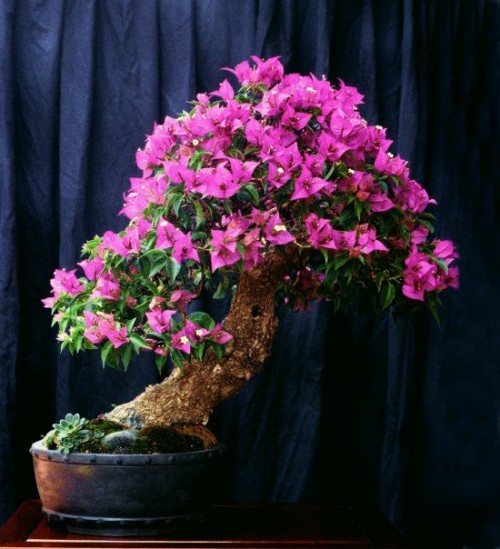
Bougainvillea. Two things stand out; the flowers and the trunk. You might also notice the how small is the pot relatively to the tree. If the purpose of this tree is to show off its colors, then you would have to say it’s a screaming success. But what if you take away the flowers? Is it still a noteworthy bonsai? Or does that even matter?
In Japan flowering trees are often designed in ways that show off the flowers first and foremost. Normal bonsai guidelines do not always apply. In some cases where the flowers come and go almost overnight, the trees are moved front and center for that brief moment and then stuck in the back of the bench for the rest of the year. Bougainvilleas have an advantage; they can flower for months at a time.
I have been thinking about offering more critiques. It is a good way to learn and advance our skills and it doesn’t just have to be about me telling you what I think. You can write as much as you want in the comments, and going a step further, you could even offer your own bonsai for criticues.
My biggest question about this tree is the pot. I think a glazed pot would be better. It could also be a little wider and shallower. The depth of this pot takes a little away from the powerful girth of the trunk.
I like the root on the right, because it expands the base of the trunk and lends stability and balance. The other root in the center of the pot looks blueish and strange in the photo. Idealy there could be a root on the left side of the trunk which would counter balance the trees lean to the right. But ideal roots are hard to come by.
andolfo Read more!