Showing posts with label ponderosa pine. Show all posts

Friday, November 25, 2011

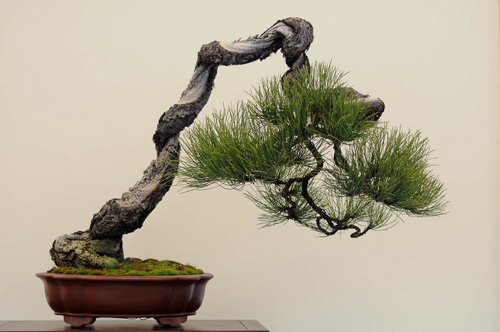
Bonsai tree: Bunjin Ponderosa Pine Styling

This was a demo tree at a convention a few years ago. My client has been keeping it healthy and it’s been budding back quite well, and we decided it was ready for a rewiring.

I’ve been surprised how well Ponderosa develops here in the Northwest. When I first moved here in 2006 I assumed there would not be enough sun to really get the budding and shorter needle growth on these pines, but having worked on a few now over a few years I have another opinion. This one will need only another three years or so of growth before it feels settled into this new styling.


Ponderosa pine before wiring


And after styling. Tree is tilted to the left to prevent vertical/horizontal sections of the trunk, and to create better drama in the flow to the right. Apex needs several years of growth to fill in.
Read more!

Monday, June 20, 2011

Bonsai tree: Local Bonsai Styles 2: Growing Conditions, NativeSpecies & Culture

This venerable, naturally dwarfed Ponderosa belongs to American/British bonsai artist and teacher, Colin Lewis. Colin lives on the coast of Maine. Ponderosa pines grow in the inland mountains of the western U.S.; two distinctively different environments.

Climate, native species and culture

If you get a chance, take a look at the comments from the last post. They expand and provide insight into what started as a simple post with a single idea: the effects of culture (human rather than biological culture) on local bonsai styles. The first three comments deal mostly with nature (climate and other growing conditions, and native species) and the forth by Colin Lewis, returns to and amplifies the notion of culture as a primary influence on bonsai styles. Rather than say much more here, I’ll let Colin speak for himself (below). But first a couple more photos.

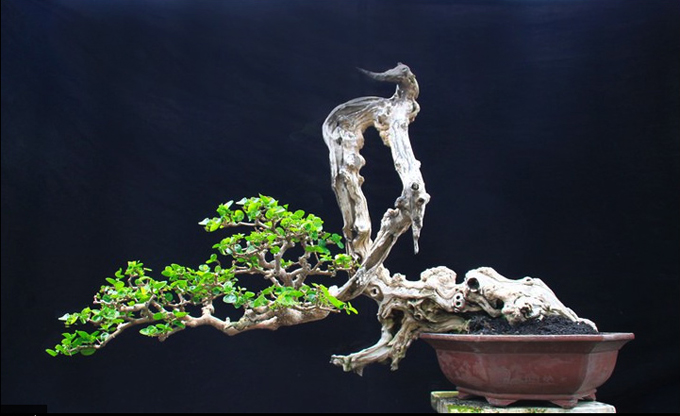
A wonderfully gnarly Premna by Robert Steven and his good friend, ‘Mother Nature.’ No way you’ll ever find a tree anything like this in the Green Mountains of Vermont or the scrub pine forests of Maine. It is distinctively tropical and almost looks like it grew in some unearthly magical realm (Indonesia, in fact). Robert is a frequent contributor to this blog and is the author of two distinguished and invaluable bonsai books: Vision of My Soul and Mission of Transformation.

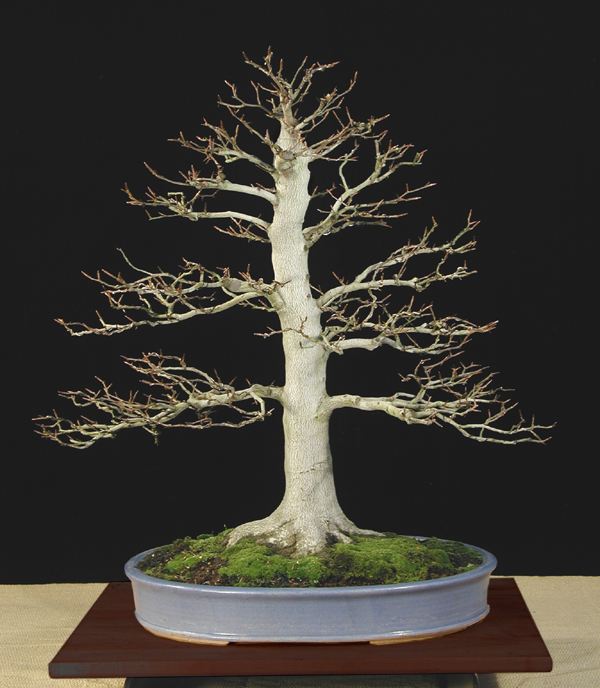
Japanese beech by Colin Lewis. This species looks like it might be quite at home in Maine. In fact, when it comes to growing conditions, Maine and the northern Japanese island of Hokkaido have much more in common than Maine and the Rocky Mountains.

Colin’s remarks from the last post

“Local growing conditions and species are only part of the story. Look again at the olives from Uruguay and Spain and you’ll see that the do indeed have a lot in common. First, they are similar material, parts of the nebari of what were much larger and extremely old trees that have long since fallen apart and left just a ring of sprouting root remnants. They are not influenced at all by ancient olives because olives simply don’t grow like that. They are in fact the artists’ responses to the material. They are brilliant works of pure fantasy.

But there is something else: both artists are of Spanish descent, they both have the Spanish flamboyance and the confidence and freedom of spirit to express it. You can feel the swirling flamenco dancers in the works of both. David’s reflects more the sophistication of Madrid, while Andres’ reflect perhaps the more ethereal Uruguayan culture. Transplant either of them to Maine and give them yamadori larch – quite different in nature, and their results would still be similar to each other and would still reflect their Spanish roots.

In North America this unity of national cultural influence doesn’t – can never – exist. In part because of all the immigrant groups who still hold on to remnants of their ethnic origins; but importantly, Americans don’t grow up surrounded by a couple of thousand years of cultural and artistic heritage to give them a common emotional expression. Chasing after a national or local style in a multi-cultural society is futile. Looking for cultural styles within that society might be more fruitful.”

Colin Lewis is the author of Bonsai Survival Manual (and several other books, now out-of-print), and is the consultant editor to The Bonsai Handbook by Robert Prescott. Colin owns and operates Colin Lewis Bonsai Art and the Ho Yoku School of Bonsai. Colin is also responsible for Ho Yoku bonsai care products.

Source: Bonsai Bark Read more!

Thursday, June 2, 2011

Bonsai tree: American Bonsai Heaven

Still a work in progress, but an exceptional work at that. Douglas fir, styled by Ryan Neil. Collected by Randy Knight.

Full tilt bonsai

Is it just me, or has Oregon quietly become bonsai heaven? Think about it; Michael Hagedorn (Crataegus Bonsai) has been hunkering down in Portland every since he returned from his apprenticeship with Shinji Suzuki in Japan. Now Ryan Neil (International Bonsai Mirai), still somewhat fresh from his six year apprenticeship with Masahiko Kimura (if you’ve heard of anybody, you’ve heard of him) has settled in the Portland area too. Both Michael and Ryan are going full tilt bonsai, and if that’s not enough there’s this other guy, Randy Knight (Oregon Bonsai) who’s a madman (in the good sense) collector of wild material that’s making a big name for himself with his ferocious eye and techniques and sensitivity that make for almost unprecedented success rates (such hyperbole, especially given that I’ve never met Randy… but I’ve seen enough photos and drank just enough coffee to go out on this limb).

Bunjin juniper, originally from Japan and styled by Michael Hagedorn. I’ve been wanting to post this sweet little tree for a long time, but have hesitated because of the lazy line and dots in the background (I’m really not a finicky person, it’s just some idea I have about standards for Bonsai Bark). But the tree has finally won me over, dots and all.
Just collected by Randy Knight. The cryptic captions say Colorado, so, given the orange bark, I’m guessing it’s a ponderosa.

This’ll give you some idea of the scope of Randy Knight’s collecting passion, perseverance and patience, not to mention his strong back.

I’m breaking another of my own rules (about featuring bonsai rather than people in photos). It’s Ryan Neil back in his apprentice days working on one of Kimura’s most famous trees.

This one speaks for itself. It’s from Ryan’s website and was taken somewhere in Japan. Is it Kimura’s nursery?


Source: Bonsai Bark Read more!

Wednesday, September 8, 2010

Bonsai tree: Grafting Results

Some of you have asked to see results of the grafting done this spring. Here are a few photos to share:


This is a Red pine graft on Ponderosa. The Red pine is the bright green foliage in the center. There are only two grafts, and I've weakened the Ponderosa shoots somewhat. Perhaps by the end of next year I'll be able to take off all the Ponderosa, and then we'll have a Red pine.


The second graft on the same tree. Although the foliage is as long as the Ponderosa right now, it will reduce considerably in a smaller pot with less fertilizer. And then there is always the possibility of using the standard Black pine technique of cutting the candles, and then we have needles as short as we like.


A Rocky Mountain juniper grafted with Chinese juniper. The grafted foliage is the tight mass in the center, and the Rocky Mountain is the droopy foliage on the bottom. This was a cleft graft, with two scions. Approach grafting is also very common and actually easier for juniper.
Read more!

Wednesday, July 28, 2010

Bonsai tree: More Than Just Pots

sara
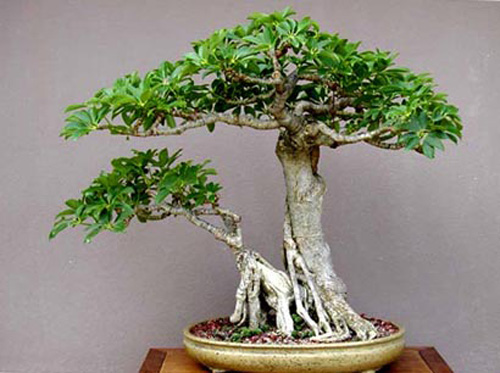
I love this schefflera by Sara Rayner, even though it’s a bit jammed in the photo. It’s completely unique and has a natural uncontrived feel. I found it and the photo below at The Art of Bonsai Project.
For a long time I thought Sara Rayner just made fine bonsai pots. I didn’t know she made fine bonsai as well. I would venture a guess that I’m not the only one who has held such thoughts, as Sara is quite well known for her pots, and less well known for her trees (at least that’s my impression). Anyway, her trees are every bit worthy of her masterful pots. Their are others in the bonsai world who make their own pots, but few who match both sets of skills so well.
sara2
Ponderosa pine and pot by Sara Rayner. Another one of a kind. The tree is unique and the tree pot combination echo that uniqueness.

Source: Bonsai Bark Read more!

Tuesday, March 30, 2010

Bonsai tree: Grafting a Ponderosa Pine

I have been grafting smaller ponderosas with black pine and red pine for some time. Before I went to Japan I grafted a very small ponderosa with 10 Mikawa Black pine scions. So I had eight grafts on a small tree…and then when I styled it years ago, I only used two grafts to create the tree, and cut the rest off. People in my backyard have been surprised it is grafted as the black pine and ponderosa bark match so well.
The first photo: A few grafts on a bankan (twisted-trunk) Ponderosa pine. The scions are a black/red pine hybrid, which I chose for the thin Red pine-looking needles. This tree has a very Red pine feel to it. And ponderosa foliage on small and moderate sized trees just does not look good to me. I know for some this is controversial, but it does look a lot better than the ugly grafted trees we see with black pine base and white pine top. And it is a way to use the wonderful material we have in a new way.
Ponderosa Pine
Read more!

Tuesday, February 16, 2010

Creating bonsai moss: ponderosa pine

It’s common, when displaying bonsai at indoor exhibits, to cover the surface of the soil with moss. The alternative dirt doesn’t really compare. Scott decorated his ponderosa pine with a great arrangement of moss and lichens at this year’s BIB exhibit.
Depending on where you live, you may have found that moss doesn’t just show up the week before exhibit. Either that or you find it difficult to keep it under control. For years now, I have taken note of all of the patches of attractive moss I run across that grow on public property. If all goes well, I will end up with a few trays like the one below:
Collected moss
Read more!

Friday, February 5, 2010

BIB’s Annual Bonsai Exhibit

BTNight
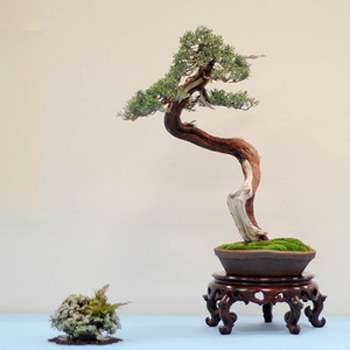
I lifted this sinuous Ponderosa pine (Pinus ponderosa) off a great gallery at Bonsai Tonight from the 2010 Bay Island Bonsai Exhibit. Though I can’t tell for sure, it looks like at least five full twists in the trunk.
Westernjun
Here’s another heavy-trunked bunjin. It’s a Sierra juniper, also known as Western juniper. It and it’s close cousin, the California juniper are becoming favorites of bonsai enthusiasts here and abroad.

Read more!

Tuesday, February 2, 2010

BIB exhibition – conifers

Bonsai exhibitions are my best opportunity to simply enjoy the trees. During BIB’s annual exhibition, I make time to wander the hall as if I were a visitor. I study bark and branch placement, moss-work, accents, and display.
One of the first things that strikes me about a tree is its balance, or “baransu,” as Yasuo Mitsuya would say. The shimpaku below has it in spades. Dense and green foliage, wonderful course to fine ramification, and a silhouette that’s as Japanese in character.
Shimpaku
Read more!