Tuesday, January 3, 2012

Bonsai tree: Ryoan-ji gardens


Source: Bonsai Tonight
Ryoan-ji Temple gardens

Kyoto’s Ryoan-ji is best known for its stone garden – a rectangular plot roughly 25 meters by 10 meters featuring several clusters of stones set in a sea of white sand. There is a total of 15 stones, but only 14 are visible from any given vantage point. The stone garden was built near the end of the 15th century. Today, it is one of the most famous zen gardens in the world and has been recognized as a UNESCO World Heritage Site.

Just beyond the walled stone garden lies a wonderful, if under-appreciated, garden featuring meandering paths and a large pond. To get a feel for how the garden is arranged, check out the virtual tours at Kyoto Gardens.org. Thanks to Tom for the tip!

The simple yet beguiling design of the garden makes it a wonderful place for quiet reflection.

Ryoan-ji stone garden

My first view of the garden – wow!

Or simply reflection. The crowd, while polite, offers quite a buzzing contrast to the spare garden.

The crowd

Enjoying solitude together

The stones themselves are great. Some sit just above the surface of the sand, others are propped up on small mounds surrounded by aprons of moss.

The largest stone

The largest stone and its mate

Most of the sand has been raked along parallel lines save for the ripples around each stone island.

Raked gravel

Ripples around stone island

The stones

Islands in the far corner

Stone appreciation

Contemplating stones and/or texting friends

Ryoan-ji stone garden

The karesansui (dry garden)

Mossy, maple-covered gardens flanked the sides of the building from which we appreciated the dry garden.

Maples in a side garden

Red leaves on green moss

Side garden

The lush garden behind the temple

Ryoan-ji’s stone washbasin boasts a unique design. It’s lower than many similar basins, and features four Japanese characters or kanji. These are meaningless when read alone, but when combined with the character formed by the basin’s square opening, “kuchi,” (mouth) they become “I,” “only,” “plenty,” “know.” From the temple brochure:

Tsukubai, the stone-wash basin for the tea room, has a unique inscription, ‘I learn only to be contented.’ He who learns only to be contented is spiritually rich, while the one who does not learn to be contented is spiritually poor even if he is materially wealthy.

Wikipedia’s interpretation: “what one has is all one needs.”

Tsukubai

Ryoan-ji’s Tsukubai


Tourists and maples

Leaving the zen garden is a peaceful experience. The garden is large, and save for the path between the entrance and the dry garden, it is mostly unoccupied.

Garden wall from the outside

The outside of the garden wall

Accents

Accents in the moss

Large stone

Large moss-covered stone

Moss

Beautiful moss

Moss

Several kinds of moss growing together

Little side-paths meandered through curious spaces planted with different species at each bend in the road.

Lage pieris

Large pieris

Shrubbery

Neatly trimmed azaleas

Mini tsugi forest

Pom-pom tsugi forest

Japanese maples were generally a sign that one was approaching the lake. Another abandoned path led to an islet in the middle of the pond.

Stone path

Stone path to islet

Enjoying the fall color

Main path to garden – “Kirei-ne?” (Beautiful, yes?)

Nandina berries

Nandina berries reveal the season

Large wisteria

Huge wisteria overhanging the pond

Tsugi on Bentenjima - the islet in the middle of the pond

Venerated tsugi trunk wrapped in protective bark

Old tsugi leaning over Kyoyochi Pond

Posts supporting the tsugi on Bentenjima, the islet in the middle of Kyoyochi pond

Pond seen through maple foliage

“Ee koyo” (Good fall color)

The pond dates from the 12th century. It originally attracted mandarin ducks, earning it the nickname “Oshidoridera” (the temple of mandarin ducks). I saw a heron on Bentenjima, but no ducks.

Kyoyochi Pond - dates from 12th century

Kyoyochi pond

Japanese maple

Japanese maple

Koyo, tsugi forest behind the temple

Tsugi forest behind the temple complex

Kyoyochi Pond

Kyoyochi pond

Kaki

Persimmon next to pond

Next stop: Kinkaku-ji Read more!

Monday, January 2, 2012

Bonsai tree: Happy New Year from a Bonsai Artist with a Magic Touch

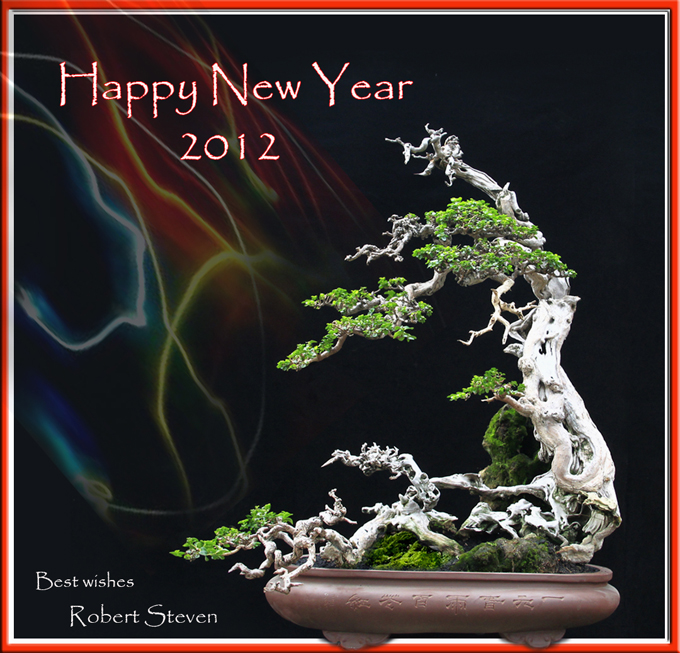
This dazzling digital New Year’s card is from our friend and colleague, Robert Steven.

Contributor, friend, colleague…

I just did a quick count; Robert Steven’s name appears in 65 of the 500 or so Bonsai Bark posts so far. A large percentage of these are Robert’s now famous bonsai critiques. Robert is also a business partner of sorts. We (Stone Lantern) are distributors of Robert’s excellent Bonsai Aesthetics tools and bonsai wire as well as his ground breaking bonsai books, Vision of My Soul & Mission of Transformation. All this adds up to relationship that benefits Stone Lantern and Bonsai Bark, and hopefully benefits you as well.

…and world class bonsai artist

It’s Robert’s artist’s vision, daring, wealth of bonsai knowledge and magician’s touch with bonsai that really defines who Robert is, at least in our world of bonsai. If you take a look at the tree above, you’ll catch a sense of what I mean. If you explore further, the evidence will continue to mount.

It’s now official, 2012 is upon us. All of us who are part of the Stone Lantern family, would like to wish you a Cheerful, Healthy and Prosperous New Year.


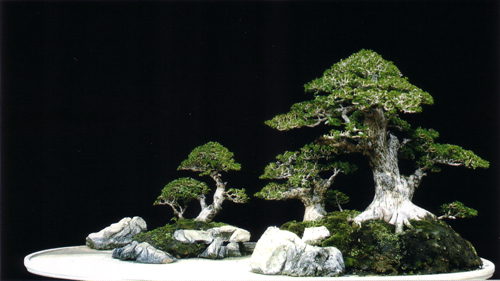
One of our earliest posts (way back in 2009) about Robert Steven featured this Penjing planting from Mission of Transformation.


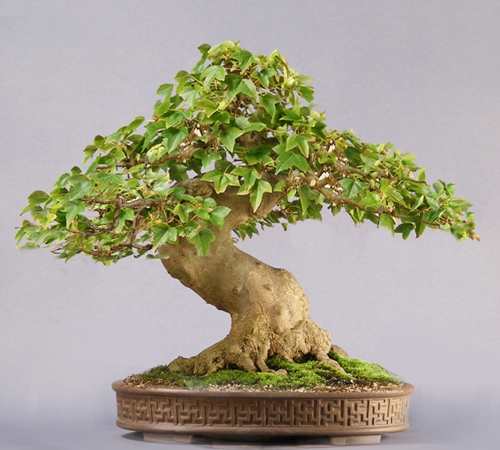
This simulation of a Trident maple is from one of our earliest critiques by Robert (September 2010).

Source: Bonsai Bark Read more!

Bonsai tree: Ninna-ji Temple


Source: Bonsai Tonight
Ninna-ji Temple

Let’s go to Kyoto! I thought I’d start out the new year with a recap of my visit to some of Kyoto’s fantastic gardens. My first stop was Ninna-ji Temple. Ninna-ji dates to the 9th century making it one of the older temples in a city full of old temples. Around a dozen buildings from different epochs surrounded by a variety of gardens make Ninna-ji a great introduction to Kyoto’s temples. The Ninna-ji website offers a brief history and an English-language blog features great photos and more detailed histories.

After exiting the Kyoto City Bus, I found myself standing directly across from the Nio-mon Gate. The gate takes its name from the Kongo-rishiki – muscular guardians – at its base.

Ninna-ji Temple - Nio-mon gate

Nio-mon Gate

Guardian at the gate - Agyo Nio

Agyo Nio – the guardian on the right

Nio-mon gate woodwork

Looking up at the gate from underneath

The Goten Palace and gardens sit just inside the gate. It is the most impressive and well-manicured area of the temple.

Goten

Black pine with very long, low branches

Goten

Japanese maple and pines behind raked sand

Many temples featured seasonal flower arrangements at their entrance. These flowers greeted guests entering the Goten Palace.

Flower display

Flower arrangement

Goten

Goten garden

Goten

Moss and pine between buildings

Goten

Shady garden

Goten

Walking through the Goten

Goten

The Goten’s North Garden

Goten

Pond, maple and pines

Goten

The Five-storied Pagoda behind the Goten’s North Garden

I was really excited to see such great Fall color. In Northern California, Japanese maples typically turn brown before dropping their leaves. The vivid oranges and reds were quite a treat!

Goten

More maples and pines

Chokushi-mon Gate

Chokushi-mon Gate

Thatch

A close-up of the thatch roof at the Goten

Shinden

Shinden

Lantern

Lantern

Roof decoration

Roof decoration

Five-storied Pagoda

Five-storied Pagoda

Koyo - Japanese maple

Japanese maples

Five-storied Pagoda

Five-storied Pagoda

Some older, more delicate, or important buildings were completely off-limits to visitors. Most buildings, however, were far more welcoming.

Hide and seek

Hide and seek

Kon-do

Kon-do

Bell tower

Bell Tower

Decoration in front of Mie-do

Decorations outside the Mie-do

Mie-do

Mie-do

Kannon-do

Kannon-do

Kannon-do

Kannon-do foundation

Omuro-zakura - cherry trees

Five-storied Pagoda beyond the Omuro-zakura orchard – dwarf cherry trees

Buddha

Buddha

Nio-mon gate from inside garden

Nio-mon gate from inside the temple

Next up: the Ryoan-ji Temple. Read more!